Your first EMS training session starts with a conversation, not a workout: a documented set of health questions, then a suit fitting, then roughly 20 minutes of deliberately light coached work. Plan about an hour for the whole visit, come in normal clothes, and expect to leave with your next appointment booked.
That is the honest summary, and it already contains the two things most first-timers do not expect: that the training itself is the shortest part of the visit, and that a properly run studio will make your first session easier than you wanted it to be. Both are deliberate, and both are worth understanding before you book - because they are also the two fastest ways to tell a serious EMS studio from a casual one.
What should I expect before the training starts?
Before anyone trains for the first time, two things happen: a health screening and a suit fitting. The screening is a short set of questions about your health, gone through in person with the trainer who will actually train you - and it is written down, not waved through. In Germany this is not a courtesy; it is how the format is meant to be run.
The questions are plain: what is going on with your health, what has happened in the past, what you take. The point is not to interrogate you - it is that 20 minutes of whole-body strength work is real training, and the person setting your level needs to know who is standing in front of them. Two outcomes are possible and both are good ones: either you train, with a level set to your actual situation, or you are told this training is not right for you before you have paid for anything. If anything in your answers needs a doctor’s look, that comes first - a studio is not the place to settle a medical question.
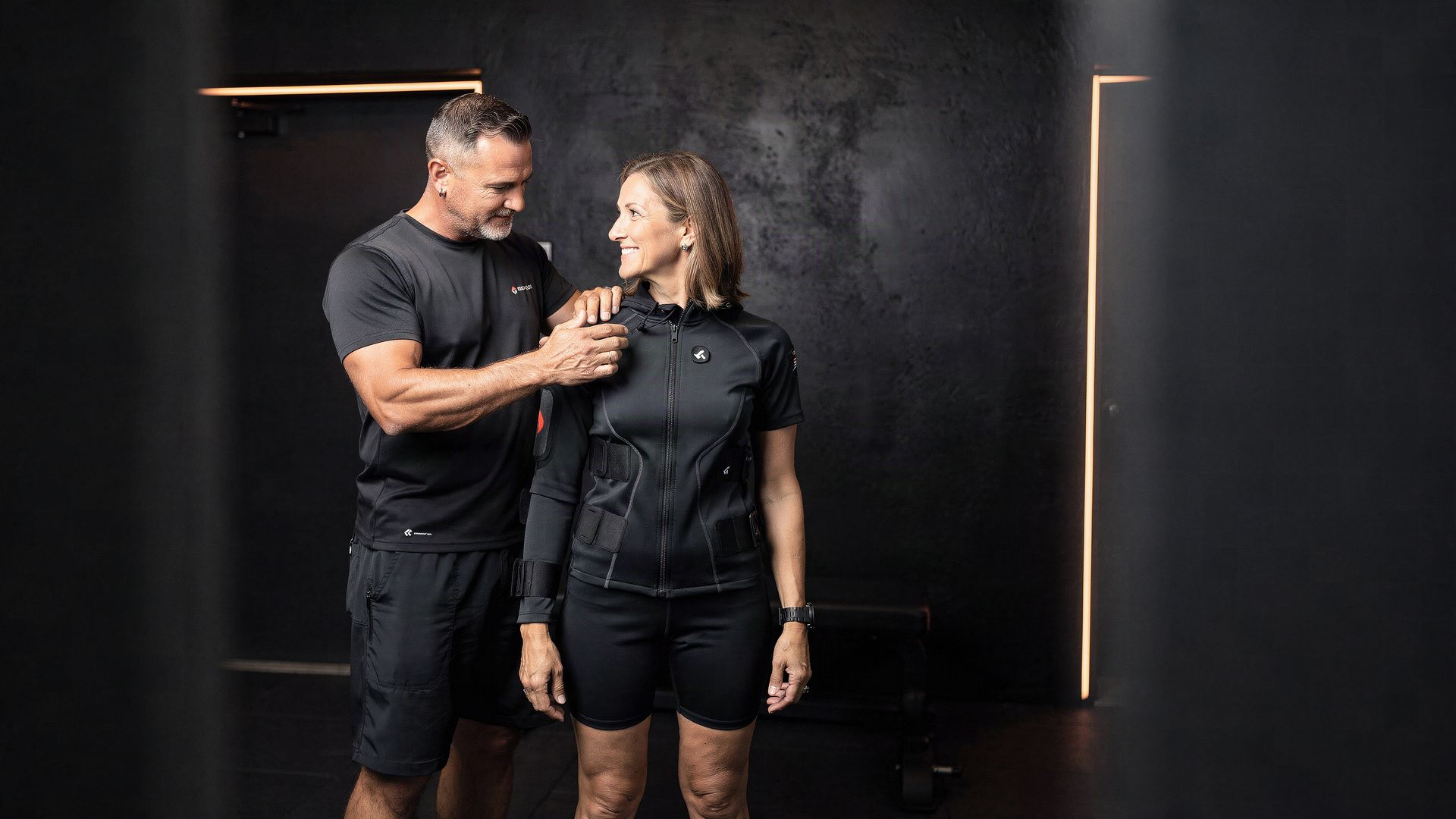
Then the fitting. The training suit - a snug, sleeved top with the electrodes built into the fabric, plus fitted shorts - belongs to the studio and is fitted to you, not handed over a counter. It sits close, closer than gym clothing, because it has to. Your trainer checks the fit at the shoulders and straps before every session, not only the first one. Come in normal clothes: you change at the studio, and whether the thin layer worn underneath is provided is on your studio’s own page.
How do the first 20 minutes feel?
Lighter than you expect, by design. The movements are simple - a squat, a press, a hold - and the impulses run in timed blocks while you move. The first blocks feel unfamiliar: a firm, even tension arriving in rhythm and fading again. By the third block it is simply training. The level starts low, and your trainer raises it with you only as far as you can hold well.
Two sensations surprise people in the first session, so here they are in advance. The first is how quickly a simple movement becomes real work: a squat you would never think about is honest effort by the fourth repetition, because the whole body is loaded through the entire movement rather than one muscle at a time. The second is how much talking happens. A first EMS training session is a running conversation - the trainer asks, you answer, the level moves. “A bit more?” is a question, and no is a complete answer.
You can stop at any moment. Mid-session, mid-block, no reason needed. That is not a courtesy either - it is written into how the format works, because the person wearing the suit is the only one who feels what the level feels like.
Why is the first session deliberately light?
Because this format is dosed by the week, and the first dose is the one your body has no reference for. A first session that stays well below your limit is the difference between training you build on and soreness that costs you the next fortnight. Studios that run the format properly treat restraint in session one as a professional obligation, not caution.
Here is the arithmetic behind it. You train once a week - that cadence is the format, supported by the international usage guideline for whole-body EMS training, and explained properly in why once a week is the whole plan. With 52 sessions a year, nothing about your first 20 minutes needs to prove anything. What the first session has to do is exactly three things: teach your body the sensation, teach your trainer how you move, and leave you well enough to come back in seven days. Muscle soreness for a day or two afterwards is normal, the way it is after any unfamiliar training - a first session run at show-off intensity would turn that into a week, and a serious studio will not let you buy that experience.
If a provider’s first offer is maximum intensity - or a “bring a friend and push each other” framing - you have learned something useful about them.
There is also a quieter reason the first session is easy, and it is the one members mention months later: the first visit is really an interview in both directions. You are learning whether the room, the trainer and the format fit your life; the trainer is learning how you move, what your history means in practice, and where your real starting level is. A session run gently leaves attention free for all of that. A session run at the redline teaches both sides nothing except that you survived it - and the format has 52 weeks a year to be demanding once the foundations are set.
What happens after the session?
Three things, in about five minutes: you change back, your trainer notes where you landed so next week starts there rather than from zero, and your next appointment goes in the book before you leave. Most people keep the same slot every week - same day, same time, same trainer.
That last detail carries more weight than it looks. The standing appointment is the mechanism that makes this format hold when a gym membership would not: it turns training from an intention into a fixture. And the note your trainer keeps is what makes week two different from week one - the level is not rediscovered each visit, it is continued. By the tenth session, the whole thing feels ordinary, which is precisely the point: the format is built for years, not for a dramatic first month.
What it costs is your studio’s own number, published on its page - the structure of what every membership includes is on the membership page.
What should I know before my first visit?
Practical answers, in one place:
| Question | Answer |
|---|---|
| How long is the visit? | About an hour; the training itself roughly 20 minutes |
| What do I wear? | Normal clothes; you change there - the studio’s page says whether the base layer is provided |
| Do I bring anything? | Just yourself |
| Will it hurt? | No - a strong, even tension you set together, never pain |
| Can I stop? | At any moment, no reason needed |
| Am I fit enough? | There is no entry bar; the level is set to you personally |
| Who is with me? | A qualified trainer, the whole session; at most one other person trains in the room (DIN 33961-5 caps supervision at 2 per trainer - why that ceiling exists) |
| What happens first? | The health questions, documented, before any first impulse |
Common questions
What should I eat or drink before a first EMS training session?
Arrive normally fed and normally hydrated - a regular meal a couple of hours before is ideal, and water with you never hurts. Do not arrive fasted, and do not arrive straight from another hard workout. Your trainer will ask; answer honestly and the level will be set accordingly.
Can I train the day after my first session?
Ordinary movement, absolutely - walk, cycle, live your life. Another hard strength session, no: the week between sessions is part of the dose, and muscle soreness after a first session is your body’s case for it. If soreness lasts beyond a couple of days, tell your trainer before the next appointment.
Do I have to sign a membership before the first session?
You should not have to sign anything beyond the documented health screening and consent. How the trial itself is handled - and its price, if any - is each studio’s own decision, published on its own page. A studio that pressures you to sign before you have trained once has answered a question you did not ask.
Do I need to prepare or train beforehand?
No. Arriving unfit is the normal case, not a problem to fix in advance - the first session is set below what you could manage precisely so that there is nothing to prepare for. If it has been years since you trained, you are the person this format was built around.