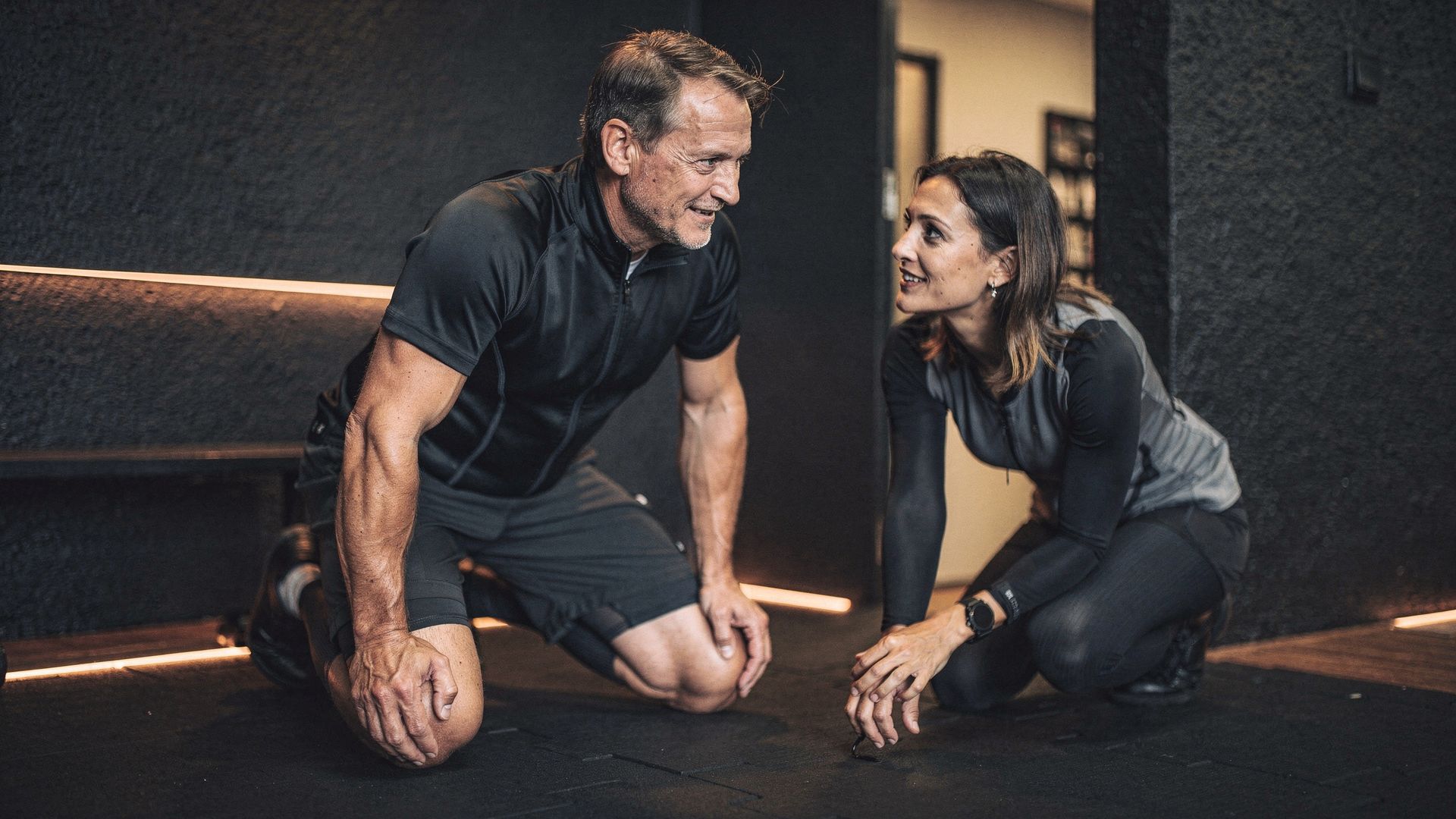
EMS training is coached strength training in a fitted suit that adds electrical impulses to simple movements, so 20 minutes of supervised work loads the whole body at once. It is done once a week - 1 session of 20 minutes - one to one or two to one with a qualified trainer, and it is a format - not a device, and nothing medical.
That definition matters more in this category than in most, because EMS training is usually explained backwards. Most descriptions start with the technology and work outwards, which is how you end up with pages about currents and electrodes that never mention the only thing that actually decides whether the training is any good: who is standing next to you, and what they are paying attention to. This page explains the format the way you would experience it - the room, the session, the cadence, the rules - and is equally honest about what the format does not do.
What is EMS training, in plain terms?
EMS training is a supervised strength session of 20 minutes in which you wear a snug training suit while performing slow, simple exercises - a squat, a press, a hold - and the suit adds impulses in timed blocks while you move. The impulses make simple movements genuinely hard work, which is why a complete session is twenty minutes rather than an hour, and why a trainer stays beside you for all of it.
EMS stands for electrical muscle stimulation. In a studio setting the letters matter less than the structure around them: an appointment, a fitted suit, a qualified trainer, and a session short enough to fit inside a lunch break. You do not operate anything yourself, you do not train alone, and you do not need any experience to start. The trainer sets the level with you, block by block, and you can stop at any moment.
The category has been part of the German studio landscape for well over a decade, and Germany is where its rules are most developed - a national standard, DIN 33961-5, governs how studios run it. That is worth knowing wherever you train, because it defines what a properly run session looks like: it is the difference between a format and a gadget.
What happens in a session?
A session is 20 minutes of coached work, by appointment, in a small room with at most one other person training. You change, the trainer fits the suit, and you work through simple movements in timed blocks while the trainer adjusts the level and watches your form. Then you are done - the whole visit fits in a lunch break.
The movements themselves would look unremarkable in any gym: bodyweight squats, presses, holds. What changes is how quickly they become real work. A squat you would not think twice about is genuine effort by the fourth repetition, because the impulses are loading the muscles through the whole movement. Most people describe the sensation as a firm, even tension that arrives in rhythm and fades again - unfamiliar for about two blocks, and then simply training.
Two structural details do most of the work in a good session, and neither is the technology. The first is that the trainer never leaves: the level is chosen with you, adjusted block by block, and corrected the moment your form drifts. The second is the room itself: with a maximum of 2 trainees per trainer, there is no queue for equipment, nobody watching, and no part of the session that happens without a professional’s attention.
We describe a first visit step by step in what happens in your first EMS training session - it differs from a normal week in ways worth knowing before you book.
How often do you do EMS training?
Once a week. A complete session is 20 minutes - 52 sessions a year on one fixed weekly appointment - and the week between sessions is part of the format, not a beginner’s allowance. The international usage guideline for whole-body EMS training supports exactly this cadence, and properly run studios do not sell more - at Robla, none does.
This is the point where EMS training differs most sharply from gym culture, and the difference confuses people in both directions. It is not that twenty minutes weekly is a taster of something bigger: it is the whole plan, built around how the body recovers from this kind of loading. A denser schedule is not a premium product - it is the format run wrongly. We unpack the reasoning, including what once a week does not do, in why once a week is the whole plan.
The practical consequence is that EMS training occupies a different place in a week than a gym membership does. It is one fixed appointment - same time, same trainer - rather than a standing intention. For people whose last training plan failed on time rather than on motivation, that single structural fact is usually the reason this one holds.
Which rules apply to EMS training?
In Germany, the reference is DIN 33961-5 - the part of the national fitness-studio standard written specifically for EMS. Its published scope caps supervision at 2 trainees per qualified trainer, and the qualification itself is regulated: EMS studios work under rules that ordinary gyms do not have.
That regulatory footing is unusual for a fitness format, and it shapes everything a careful studio does: who may run a session, how many people may train at once, what happens before a first session, and what is recorded. It also gives you, as a reader comparing providers, a very short checklist that cuts through marketing - four questions we publish openly in our studio pages, and which any good EMS studio should answer without hesitation: who is in the room and what qualification do they hold, how many people does one trainer take at once, what happens before the first session, and what is the notice period after the initial term.
At Robla, the whole operating standard is public - not a summary, all of it, on the safety and standards page. Every studio opens under the same rules, wherever it is. We think publishing the rules is what a standard is for.
Who is EMS training for - and who is it not for?
It suits people who want real strength work with professional supervision in very little time - especially people starting again after years away, because the first sessions are deliberately light and nobody needs any base fitness to begin. It is not for everyone: a health conversation comes before the first session, and some people are advised not to train.
The honest version of the audience question is unusual for the fitness industry, so it is worth spelling out:
- Starting again is the normal case, not the exception. The format’s short, coached, appointment-based structure is built for people who have not trained in years - the first session stays deliberately below what you could manage, and progress is built weekly from there.
- You do not need to be fit to start. There is no entry test and no expected baseline. The level is set to you, not to a class.
- Some people should not train. EMS training is demanding work, and a documented screening happens before anyone’s first session - a few questions about your health, gone through with the person who will train you. If the answer is that this training is not right for you, a properly run studio says exactly that and does not sell you a membership. Anyone with a medical condition should speak to their doctor first - that conversation belongs there, not in a studio.
- It is training, and it makes no medical promises. If something is wrong, it belongs with a doctor - and a serious studio says that sentence out loud rather than working around it.
Where does EMS training come from, and how established is it?
EMS training grew up in Germany, moved from professional sport into boutique studios in the late 2000s, and has been an ordinary part of the German training landscape for well over a decade - long enough to have its own national standard, its own trainer-qualification rules and its own established studio market alongside a gym industry of more than 11 million members (per the national fitness association, DSSV).
That history matters to a reader in one practical way: this is not an unproven gadget category. The format has been run at scale, in the most rule-bound fitness market in Europe, for years - which is why its open questions have written answers. How many people may train per trainer: written down. What must happen before a first session: written down. Who may run a session at all: regulated. Very few fitness formats can point to a paper trail like that, and it is fair to hold every EMS provider to it, including us.
It also explains the format’s particular shape in Germany, Switzerland and beyond: small studios rather than big floors, appointments rather than open doors, one or two people in the room rather than a crowd. The format did not choose smallness for aesthetics - supervision at a 2:1 ceiling makes small rooms the only honest architecture. When you walk into an EMS studio and it looks more like a practice than a gym, you are looking at the standard, expressed as a floor plan.
The market context is also why comparisons matter so much in this category. Nearly everyone who considers EMS training is really weighing it against something - the gym they stopped attending, the personal trainer they cannot justify weekly, the home plan that did not survive its second week. The honest comparisons are laid out spoke by spoke: against the gym in full, and the others as the journal grows.
How does EMS training compare with the alternatives?
Against the gym, personal training and training at home, the honest comparison is structural: what your time buys, who supervises it, and what holds when motivation dips. EMS training trades volume for supervision - the least time and the most attention per session of any format here.
| EMS training | Gym membership | Personal training | Home workouts | |
|---|---|---|---|---|
| Time per week | 20 minutes | 2-4 hours typical | 1-2 hours | varies, often lapses |
| Supervision | qualified trainer, whole session | none by default | full session | none |
| People in the room | you plus at most one | a gym floor | you | you |
| Cadence | once a week, fixed appointment | self-directed | as booked | self-directed |
| What is documented | screening and each session’s level | usually nothing | varies | nothing |
| Falls apart when | you skip the appointment | motivation dips | budget ends | week two |
The table is deliberately unscored, because the right answer depends on what you are solving for. If you love training and have the hours, a gym gives you volume nothing else matches - and we say so plainly in EMS training or the gym. If you want a professional’s full attention on your technique for whole hours, personal training is the deeper version of what EMS training does in twenty minutes. What EMS training owns is the corner of that map where time is the scarcest resource and supervision is non-negotiable.
What does EMS training cost?
Studios set their own membership prices, so there is no honest national number - and you should distrust any provider quoting one. The structural facts that shape cost: sessions are one to one or two to one with a qualified professional, memberships run monthly with cancellation after an initial term, and the price is published by the studio itself.
The reason a page like this will not give you a figure is not coyness. EMS studios are small, locally run businesses - in Robla’s case, each studio is independently operated and publishes its own price on its own page, so the number comes from the people who will actually train you. What we can tell you is the fair comparison class: with a trainer beside you for every minute, the format prices against coached training, not against a gym’s door-access fee. How membership is structured - and the questions worth asking any provider before signing - is covered in how membership works.
What does EMS training not do?
It does not replace a doctor, it promises nothing medical, and it does not turn 20 minutes into a magic equivalent of a training week. It is strength work: coached, dosed, and honest about its limits.
Three limits worth stating plainly, because parts of this industry blur them - and because the limits are, in the end, why the format can be trusted. A product that needs inflated promises is telling you its plain description is not enough. This one’s plain description is the sale:
- No health promises. You will find pages elsewhere listing conditions this training supposedly helps. We do not make those claims in any language - if something hurts, see a doctor first, and bring what you learn to the screening.
- No transformation timetable. Anyone promising a specific body in a specific number of weeks is selling the promise, not the training. What this format offers is steady, supervised strength work that fits inside a real life - the kind you notice in ordinary things: carrying, lifting, standing up.
- No shortcut arithmetic. Twenty minutes is not “hours in the gym, compressed”. It is a different product: less volume, far more supervision, and a dose designed for exactly one session a week.
A format you can only sell by promising outcomes is not being sold on its training. This one holds up without the promises.
Common questions
Is EMS training safe?
Run properly, it is training under closer supervision than almost any other fitness format: a qualified trainer beside you, a maximum of two trainees at once, a documented health conversation first, and a level you control and can stop at any moment. The German standard DIN 33961-5 exists precisely so “run properly” is defined, not implied.
Does EMS training hurt?
No. The sensation is a firm, even tension that arrives in rhythm with the blocks and fades between them - strong, but chosen with you and adjustable at any moment. It is demanding in the way training is demanding, not painful. Anyone describing shocks is describing a badly run session.
Can I do EMS training at home?
The format described on this page cannot be, because supervision is not an accessory to it - it is the product. A qualified trainer setting the level and watching your form is what makes twenty intense minutes safe and useful. Consumer gadgets marketed for home use are a different thing entirely and are not what this page describes.
Do I need to be fit to start?
No. The first session is deliberately lighter than you could manage, the level is set to you personally, and most people who train this way are starting again rather than arriving fit. If anything in your health history needs a look first, the screening exists to catch it - and a doctor’s word comes before any first session.