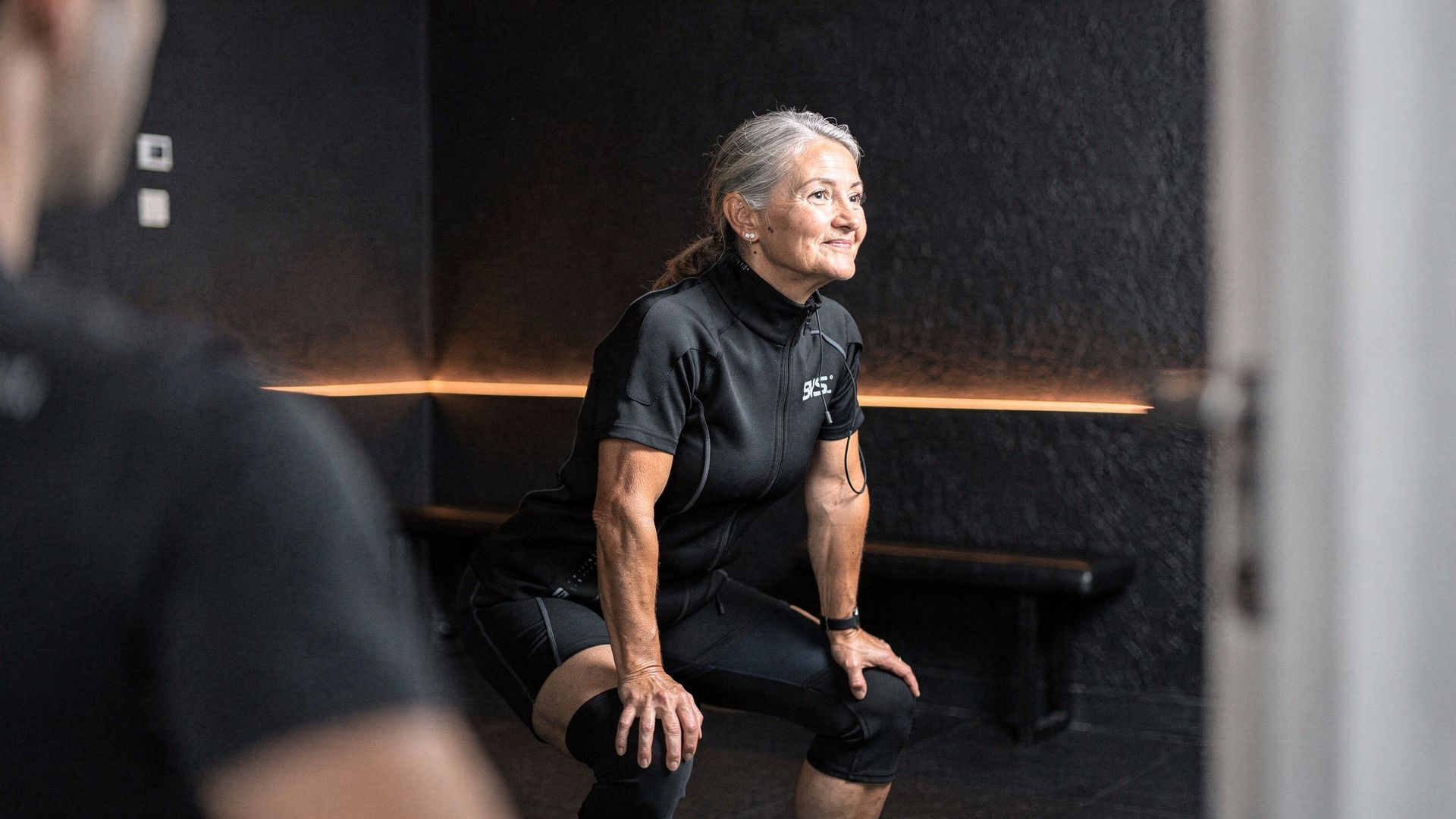
EMS training is safe the way strong training is safe: through supervision. Run properly, every session has a qualified trainer beside you, never more than 2 trainees per trainer - a ceiling named in the German standard DIN 33961-5 - a documented health screening before the first session, and a level you set together and can stop at any moment.
Notice what that answer is made of: rules, not reassurance. That is deliberate. “Is EMS training safe” is the most searched safety question in the category, and the honest response is not a soothing adjective - it is a description of the structure that makes intense training safe, plus a way to check whether a given studio actually has it. This page gives you both.
Why does EMS training need supervision at all?
Because it is strong training whose intensity is set from outside your own effort. In conventional training your muscles can only do what you ask of them; in EMS training the impulses load the whole body through every movement, so the person choosing the level carries real responsibility. That is why the format’s rules put a professional beside you - not as a service tier, but as the mechanism of safety.
This is the honest heart of the category, and it is strange that so much marketing hides it. The same property that makes 20 minutes of EMS training genuinely productive - whole-body loading, dosed precisely, on simple movements - is the property that demands a qualified person watching your form and holding the dial. Remove the supervision and you have not made the format cheaper; you have removed the part that made it defensible.
Supervision in a properly run session is concrete, not ceremonial. The trainer fits the suit and checks it before every session. The level is chosen together, block by block, and moves only as far as you can hold with good form. The trainer watches the movement, corrects it, and adjusts - a running conversation, twenty minutes long. And stopping is always yours: mid-block, mid-session, no reason required. What a full session contains is described in the category guide; the point here is that none of it happens unattended.
What does the two-per-trainer rule mean?
It means that in a properly run EMS studio, one qualified trainer is responsible for at most 2 people at a time - a ceiling that appears in the published scope of DIN 33961-5, the German standard for EMS studio operation. In practice it defines the room: an appointment, at most one other person, and a professional whose attention is never divided further.
Germany is the reference market for this format, and the existence of a national standard - with its own part written for EMS - is the single most useful fact a consumer can know about it. It converts safety from a brand promise into a checkable rule. A ratio of 2:1 is not what marketing looks like; it is what a standard looks like. Where the standard is followed, an EMS studio is structurally incapable of becoming the thing people fear from gyms: a crowded floor where nobody is watching.
The ceiling also quietly answers the cost question people are too polite to ask: why supervised formats price the way they do. A trainer who may take at most 2 people cannot be diluted across a floor of 30 - the attention you are paying for is arithmetically incapable of being oversold. That is rare in fitness, where most memberships price access and hope for absence. Here the cadence and the ratio together fix what you get: 20 minutes, a professional, at most one other person, every week.
At Robla the ceiling is written into every studio’s licence, wherever the studio is, and the whole operating standard is published - all of it, publicly, before a single studio has opened. First studios open in 2027; the rules they open under exist now and can be read now. We think that order - rules first, addresses second - is what taking a standard seriously looks like.
What happens before anyone trains for the first time?
A documented health screening: a short set of questions about your health, gone through in person with the trainer, written down before any first impulse. Its two honest outcomes are a level set to your real situation - or a plain “this training is not right for you” before any money changes hands.
The screening is where the format’s seriousness is easiest to check as a consumer, because pretending is hard. A real screening happens with the person who will train you, takes questions about your health history and medication seriously, sends medical questions to a doctor rather than answering them across a counter instead of answering them in a studio, and is recorded. A fake one is a form on a clipboard between the door and the changing room. If you experience the second kind, the studio has told you how the rest of its rules are run. What the first visit looks like when it is done properly is worth reading before you book anywhere.
Two groups deserve a plain sentence here. If you have a medical condition, are pregnant, or are in any doubt: speak to your doctor before a first session - that conversation outranks any studio’s opinion, ours included. And if a studio’s screening waves you through in 30 seconds, walk out - a screening that cannot say no is not a screening.
How do you check a studio’s supervision before joining?
Ask 4 questions and expect immediate answers: who is in the room while I train and what qualification do they hold, how many people does one trainer take at once, what happens before my first session, and what is the notice period after the initial term. A well-run studio answers all four without reaching for a brochure.
These four travel well - they work on any EMS studio anywhere, ours included, which is why we publish them ourselves. Here is what the answers should look like, and what each one is checking:
| Question | The answer you want | What it verifies |
|---|---|---|
| Who is in the room, and qualified how? | A named, qualified trainer, present the whole session | supervision is real, not nominal |
| How many trainees per trainer? | Never more than 2 | the ceiling DIN 33961-5 names is held |
| What happens before my first session? | A documented health conversation | screening exists and is taken seriously |
| Notice period after the initial term? | Monthly | the contract does not need to trap you |
The 4th question looks commercial, but it belongs on a safety list: notice of 1 month after the initial term is the honest shape, and a format confident in its own quality does not need long lock-ins to keep members. Contract design tells you how a business expects to be judged. At Robla, cancellation after any initial term is monthly, in every studio - a rule of the system, not a favour of the studio.
Common questions
Is EMS training safe for beginners?
Run properly, beginners are exactly who the structure is built around: the screening happens before anything else, the first session stays deliberately below your limit, and the trainer sets every level with you. Arriving unfit is the normal case. What a beginner should avoid is not the format - it is any studio running it without the structure this page describes.
Who should not do EMS training?
Some people should not train this way, and a written screening exists precisely to find out - it is a question for that conversation and, wherever health is involved, for your doctor first. Be wary of any provider whose answer is a quick online list: a list on the internet cannot examine you, and this format’s own rules say a person must.
Can anything go wrong in a supervised session?
It is training, and training is demanding - muscle soreness afterwards is normal, especially early on. The structural protections are that the level rises only as far as you can hold well, the trainer never leaves, and you can stop at any moment. Those three cover the risks that matter when the rules are followed - which is why the rules, not the reassurance, are the answer. What the structure cannot absorb is a provider that skips it: an unscreened first session at show-off intensity is not this format, it is its counterfeit. The 4 questions above exist so you never have to find out the difference in person - ask them before you change into anything, and let the quality of the answers make the decision for you.
Is EMS training regulated?
In Germany, yes, in an unusually concrete way: trainer qualification is regulated by law, and the German standard for EMS studios, DIN 33961-5, sets the 2-per-trainer supervision ceiling on top of that. Elsewhere the picture varies - which makes the four questions above more useful, not less, since they check the substance no matter what the local paperwork says. A standard you can quote beats a promise you have to trust.